
Digital 2027: AI Use Around the World
Less than four years after the public launch of ChatGPT, it already seems clear that artificial intelligence (AI) will be the defining innovation of this generation.
The use of AI has spread around the world at unprecedented speed, and – as we’ll explore in this article – these tools have already found roles in almost every aspect of people’s daily lives.
However, analysis of AI trends often focuses on highly specific metrics, such as active user numbers for an individual platform, or how often a brand name gets cited in AI answers.
These data points have clear value of course, but we also need to understand the bigger picture.
So, in this article, we’ll review a wealth of different research, offering clear insights into:
How many people use AI
What people use AI for
Which AI tools and platforms people use most frequently
How the use of AI influences purchase decisions
How AI use has affected other digital behaviours
As with all of our Digital 2027 Deep Dive content, this article is intentionally long and detailed, so you might want to grab a coffee and a snack before going any further.
OK, all set?
Global AI adoption
Despite trillions of dollars of investment and seemingly endless media coverage, it’s still remarkably tricky to put an exact figure on global AI use.
And that’s partly because there’s precious little consensus on what “AI” actually encompasses.
Just as people continue to argue about whether YouTube should be considered a “social media” platform, pundits also seem unable to agree on whether we should include AI search summaries in our assessment of AI “use”.
But these arguments miss the point: if our audiences think they’re using AI, that’s potentially a more important indicator of AI’s potential than any agreement on definitions.
So, what do people say when they’re asked if they use AI?
Self-reported AI use
Somewhat startlingly, more than 85 percent of the online adults surveyed in GWI’s latest research say that they’ve used AI at least once during the past month.
As you might expect though, self-reported AI use varies meaningfully by geography, and often in ways that confound stereotypes.
For example, GWI’s data indicates that people in less developed economies are more likely to use AI than people in Northern America or Europe.
For context, GWI’s “Core” survey only includes respondents aged 16 and above, and it also only covers 53 of the world’s largest economies.
However, those 53 geographies account for 78 percent of the world’s total internet users, and 70 percent of the world’s total population.
And for added context, the company surveyed more than 235,000 people for its most recent Core research wave (Q2 2026).
So, while it’s important to acknowledge that GWI’s survey may not be representative of all the world’s countries, its findings are still exceptionally valuable – especially when we consider that the survey covers countries such as Ghana, Nigeria, and Kenya.
And by extrapolating values for countries in GWI’s survey to other countries with similar levels of economic development, we can draw some rough inferences for overall global AI use.
Extrapolated adoption rates
Based on our elaborations of the latest data, Manochi’s analysis indicates that 83.5 percent of all internet users aged 16 and above use AI each month, equating to more than 4.1 billion people.
If we translate these findings to the population as a whole (i.e. not just internet users), the current data suggest that roughly 2 in 3 adults aged 16 and above around the world now use some form of AI each month.
Perhaps more importantly though, that absolute user figure for people aged 16 and above is already enough to push the current AI adoption rate to 49.5 percent of the global population, regardless of age or internet access.
And if just 50 million people below the age of 16 use AI today, that would be enough to push adoption rates beyond 50 percent of the population.
For context, there are currently more than 500 million children between the ages of 12 and 15 around the world, and this age group appears to have been quick to find uses for AI tools.
Half the world uses AI
So, even if just 10 percent of high-school age students use AI today, it seems reasonable to conclude that more than half of humanity already uses AI.
However, as we’ll explain below, our estimates for the use of generative AI platforms like ChatGPT and Google Gemini are somewhat lower than this overall AI adoption figure.
AI adoption rates by country
But let’s return to GWI’s data for AI use by country, because these numbers offer some particularly valuable insights.
At the top end of the scale, a hefty 97.3 percent of internet users aged 16 and above in Kenya say that they’ve used some form of artificial intelligence within the past month, while the equivalent figure for Nigeria is 96.6 percent.
It’s critical to stress that these figures represent share of internet users, and with overall internet adoption rates in these countries still well below the global average – 40.6 percent in Kenya, and 47.5 percent in Nigeria – AI adoption rates across the population as a whole will be significantly lower than these figures for AI use amongst internet users suggest.
For context, a study conducted by Pew Research found that Kenya had the lowest levels of AI awareness amongst the 25 countries covered in its survey, although it’s important to note that this particular study was conducted in early 2025.
Furthermore, while our analysis of the available data indicates that AI adoption is rising quickly across Africa, GWI’s data reveals that Ghana sees the lowest rate for AI adoption amongst online adults in the company’s latest survey, at just 35.8 percent.
There’s nothing within this data to explain why these African nations see such marked differences in the adoption and use of AI tools, nor how these rates might evolve during the months ahead.
However, these findings are yet another stark reminder that digital behaviours often vary meaningfully by geography, culture, and demographics, and it’s critical to explore local nuances in detail if different geographies feature in your activities [see our comprehensive Digital 2027 report for broader context].
And as a side note, it’s also crucial to highlight that Africa appears to be significantly under-represented in AI models’ source material, with a study conducted by GIZ finding that barely 2 percent of AI training data comes from the continent.
But broadening our geographic perspective, why might AI adoption rates be so much lower in richer countries, especially when these countries tend to enjoy the highest rates of broader digital access?
Age plays a role in AI use
One of the simplest factors here may be age.
GWI’s data indicates that younger generations are currently the most avid users of AI, with adoption rates trending down markedly as survey respondents get older.
For example, 93.3 percent of online adults aged 16 to 24 say that they used AI within the past month, compared with just 52.2 percent of respondents aged 65 and above.
And when we consider that the median age across the European Union is close to 45, there’s a plausible argument to be made that age plays an important role in the region’s lower levels of AI adoption.
However, the role that age plays in these trends may not be the result of changes in physical and mental faculties as people get older.
Rather, attitudes and perceptions of AI appear to vary markedly by age, and these differences are more likely to determine the differences that we see in AI use by age.
For example, 34.0 percent of internet users between the ages of 16 and 24 believe that AI benefits society, whereas just 16.8 percent of online adults over the age of 65 share that opinion.
And on a more personal level, 35.9 percent of that younger cohort believes that AI enhances their own daily life, compared with just 13.5 percent of online retirees.
Older generations are also less likely to express confidence in using AI tools.
For example, GWI’s data reveals that 33.0 percent of internet users aged 16 to 24 feel comfortable using AI, compared with just 16.2 percent of internet users aged 65 and above.
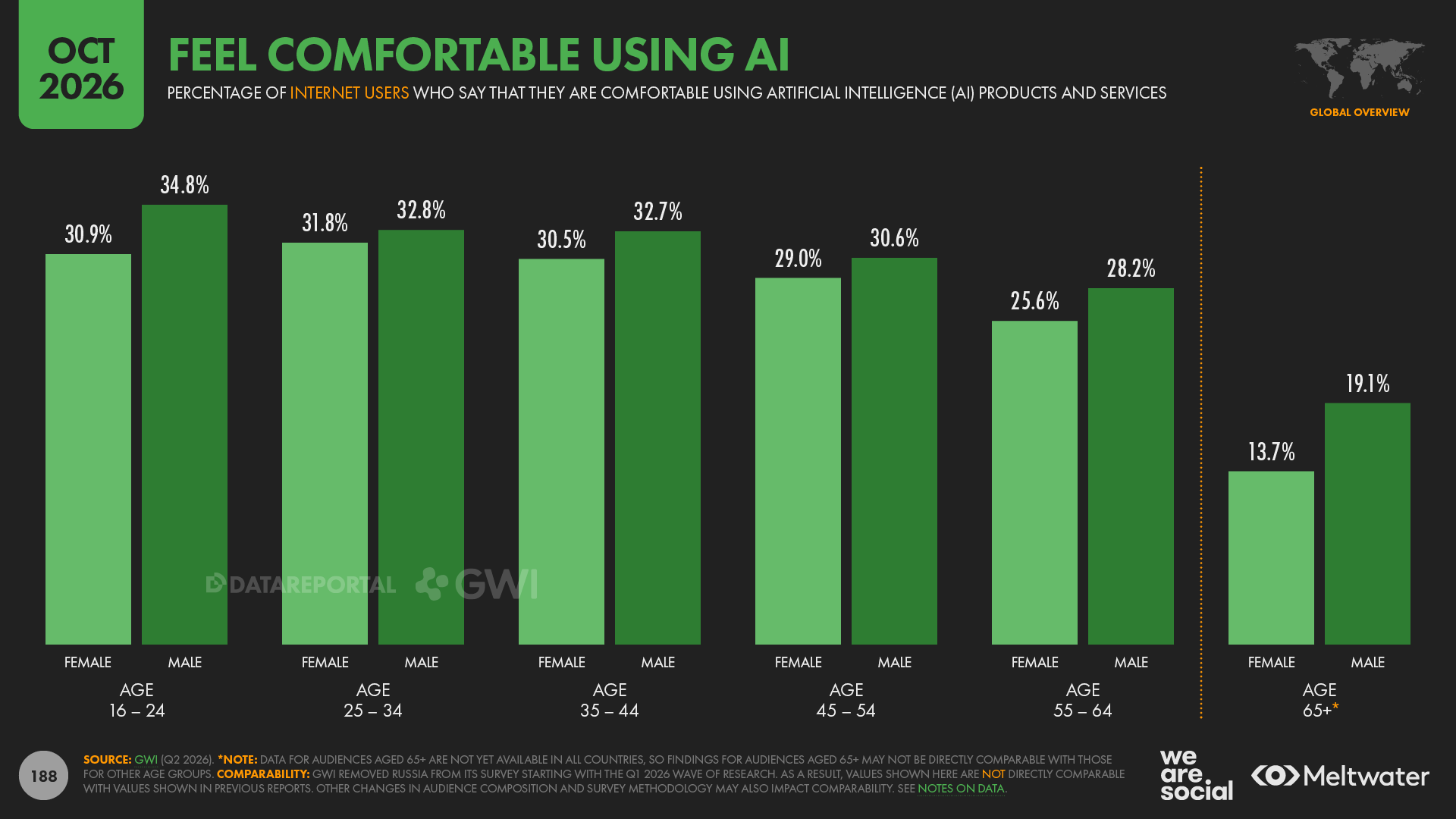
And while there’s clearly more to AI adoption rates than these factors alone, it’s interesting to note that internet users across Europe and the USA are considerably less likely to say they’re comfortable using AI compared with the worldwide average.
Similarly, people in the EU and the USA appear to have more negative views of AI, with fewer than 1 in 4 online adults across these geographies saying they believe AI benefits society.
For comparison, nearly half of Indonesian internet users – 47.2 percent – believe that AI is a force for societal good, and 40.8 percent of their Egyptian peers concur.
What people use AI for
But what do people use AI for?
As we see with broader internet motivations, “finding information” ranks as the most frequently cited motivation for using AI tools.
Across geographies and demographics, GWI’s most recent wave of research finds that more than 6 in 10 active AI users – 60.4 percent – turn to AI tools for this particular purpose.
“Getting advice on problems” ranks second with 40.6 percent, and this is a particularly interesting finding, because it helps us make sense of how people view AI’s role in their lives [more on this in a moment].
“Learning or improving skills” places third amongst the answer options presented in GWI’s survey, with 38.4 percent of active AI users identifying this as a primary reason for using AI.
And it’s also interesting to note that more than a quarter of AI users cite “entertainment” as one of the main reasons why they use AI tools today.
We’ll explore some of these motivations in more detail below, but before we do, it might help to look at how motivations vary by geography and demographic.
AI motivations by country
One of the most important findings in GWI’s data is that AI motivations vary meaningfully by culture.
For example, AI users in Saudi Arabia are more than twice as likely as users in Denmark to use AI to monitor or improve health and wellbeing (29.1 percent versus 13.6 percent, respectively)
Similarly, AI users in Morocco are more than three times more likely to use AI for entertainment compared with AI users in Poland (40.1 percent versus 13.2 percent).
And given the differences in the tools that people can access behind the country’s “Great Firewall”, it’s particularly interesting to see that AI motivations in China are markedly different to those we see elsewhere.
For example, while “finding information” remains Chinese users’ top reason for using AI, China is the only country in GWI’s survey where fewer than half (48.3 percent) of active AI users cite this as a primary motivation.
On the other hand, compared with users in other countries, China’s AI users are proportionately more likely to cite getting personalised recommendations, managing health and wellbeing, or using AI to save time and increase efficiency.
Note that you’ll find all of the individual charts for these behaviours in our complete Digital 2027 Global Overview Report.
AI motivations by age
Some other interesting differences emerge when we explore AI motivations by age too.
For example, while “finding information” remains the primary reason for using AI across all age groups in GWI’s survey, its relative importance varies by age group.
Interestingly, older users are the most likely to cite this motivation, with nearly 4 in 5 active AI users over the age of 65 (78.5 percent) selecting this answer option.
Meanwhile, AI users aged 16 to 24 are more than 4 times more likely than users over the age of 65 to cite “learning or improving skills” as a primary AI motivation.
It’s also interesting to note that the relative ranking of “personalised recommendations” appears to increase with age.
In absolute terms, younger generations are still more likely to cite this motivation, but they’re also more likely to identify a wider variety of other motivations ahead of this particular activity.
For example, just under 1 in 3 users aged 16 to 24 (32.3 percent) say that they use AI tools for personalised recommendations, ranking this activity seventh amongst the options available in GWI’s survey.
Meanwhile, just 21.8 percent of active AI users aged 65 and above say that they use these tools for personally tailored recommendations, but this is sufficient to rank this motivation third for this cohort.
And given the research we’ll explore in the next section of this article, it’s also worth highlighting the consistently high ranking of “getting advice on problems”.
AI as counsellor
The relative importance of using AI for advice on problems is clearly evident in other datasets, too.
For example, the latest research from AI in the Wild’s Marc Zao-Sanders and Sara Biuk indicates that “therapy and companionship” remains people’s primary AI use case, echoing the findings from their previous research that we explored in last year’s report.
Moreover, in their analysis of this year’s findings, the duo report that this activity is still gaining momentum:
“We found more than 1,400 [therapy and companionship] entries this year, constituting 11 percent of our dataset – up from 5 percent last year – so it’s grown quickly in absolute and relative terms.”
AI counselling in context
It’s important to note that AI in the Wild’s research relies on a relatively novel analysis of content posted to social media, forums, and online communities such as YouTube, TikTok, Reddit, LinkedIn, and Quora.
And – as the authors themselves note – there are both advantages and disadvantages to this approach.
For example, the source data may overindex for use cases that are inherently “conversation-worthy”, while simultaneously underindexing for activities that people are less comfortable discussing with others.
However, as long as we’re cognisant of the potential skews and biases within this dataset, I believe that these same factors are precisely what makes this research so interesting and valuable, not least because these elements can help us understand the role played by word of mouth in influencing people’s discovery and use of AI tools.
And furthermore, more “conventional” research echoes some of their findings.
For example, we’ve already seen related trends in GWI’s research, while a separate Ipsos survey spanning 21 countries found that more than half of respondents – 52 percent – expressed some degree of “excitement” about using AI for companionship.
This compares with 37 percent who said they weren’t excited, while 10 percent said they “didn’t know”.
The pros and cons of AI companionship
But what exactly does “therapy and companionship” look like in real-world AI use cases?
On one hand, Zao-Sanders and Biuk note that people’s interactions with AI often mimic their interactions with more “sentient” beings:
“Our data has many examples of people anthropomorphising AI. It shows that people call AI chatbots by their names, or even name them anew.”
But at the same time, the duo also suggest that people are using AI tools to improve their relationships with other people, and the ‘non-sentience’ of AI tools may deliver something of an advantage in this regard:
“[People often use] AI to enable better interactions with other human beings, rather than seeing and using AI as a human surrogate. This applies both at home… as well as at work. In this context, people seem to prefer non-human characteristics of AI, seeing AI as a reprieve from human judgement.”
Their 2026 study also suggests that people are increasingly turning to AI tools to seek emotional and relationship advice:
“AI is also becoming a go-to for people seeking help for emotional issues, including comfort or advice about personal relationships.”
However, their analysis goes on to highlight the risks associated with relying too heavily on AI “relationships”:
“There’s some cause for concern here. High-profile cases of AI psychosis and stories of AI romance over the past year have shown that therapeutic and emotional relationships with AI are high-stakes, and can lead to heartbreak and even death.”
Furthermore, Zao-Sanders and Biuk report that experts are expressing concern about people using AI as a substitute for mental health professionals.
As the authors themselves posit,
“Algorithms we don’t understand are increasingly managing and influencing our most intimate relationships. Is this healthy? Is this desirable? What powers of resistance do we still have?”
But there’s another dimension to this issue too: surging rates of loneliness.
As we explored in last year’s analysis, the World Health Organisation (WHO) has declared loneliness to be a “pressing global health threat”, and the organisation stresses that loneliness can have an alarming impact on human health:
“Loneliness is far more than just a bad feeling – it harms both individual and societal health. It is associated with a greater risk of cardiovascular disease, dementia, stroke, depression, anxiety, and premature death. The mortality impact of being socially disconnected is similar to that caused by smoking up to 15 cigarettes a day, and [is] even greater than that associated with obesity and physical inactivity.”
So, while research demonstrates that there are irrefutable risks associated with people becoming overly dependent on AI “relationships”, there may also be potential benefits associated with moderate AI use and interaction, even if such interactions are a poor substitute for real human relationships.
Surprising uses of AI
But this year’s Zao-Sanders and Biuk study reveals a number of other eye-opening findings beyond using AI as a counsellor.
Out of the 100 use cases detailed in their research, four in particular caught my attention:
Astrology and tarot readings (9th position)
Creating fake reality TV content (11th position)
Finding purpose (85th position)
Interacting with the deceased (86th position)
These don’t appear to be “edge cases”, either.
For example, “astrology and tarot readings” rank higher than “organising my life” (14th), “editing text” (20th), and “vibe coding” (21st).
As we noted earlier though, this particular dataset may skew heavily towards more “conversation-worthy” topics, and rank positions should be viewed with that caveat in mind.
Indeed, based on broader evidence, it seems unlikely that “autonomous agentic operations” are currently the sixth most common use case for AI, and my reading of this particular finding is that “autonomous agentic operations” are more likely to be the sixth most talked about use of AI.
That’s still a valuable finding though: even if the number of people who’ve adopted such agents likely remains relatively small, there’s a sizeable body of people who believe that the use of these tools will become more prominent.
However, recent history reminds us that headlines and hyperbole can be poor predictors of the tools and technologies that gain enduring, real-world traction… remember the metaverse and NFTs?
In other words, while autonomous agents doubtless offer valuable potential, it’s critically important for businesses and marketers to temper their expectations; at best, mass adoption and use of these tools is still some way off, and investing your time in understanding broader AI behaviours will likely deliver more valuable returns in 2027.
Reading the numbers
But prioritisation aside, what should we make of use cases like astrology, finding purpose, and interacting with the deceased?
At first glance, it can be tempting to conflate the popularity of AI-generated horoscopes with some kind of misplaced belief that AI is an omniscient “higher being”.
However, while significant numbers of people regularly consult tarot readings in all their forms, research often concludes that people do not actually rely on these activities for any meaningful guidance on life decisions.
And in fact, many people appear to use these activities as a source of inspiration for self-reflection and introspection, which is quite different to the stereotype of asking a fortune teller to predict the future.
Interestingly, people may once have turned to tarot readers to conduct seances in order to “interact” with the deceased too, but something about this particular activity feels considerably more moving than asking an LLM for a horoscope.
And while this activity may draw parallels with a particularly dark episode of Black Mirror [note: potential spoilers], the study of such behaviours could also offer valuable insights for anybody working in the fields of grief and trauma counselling.
However, when it comes to people using one of the most powerful technological developments in human history to create fake reality TV content, quite honestly, I’m at a loss for words.
Adult “companions”
Meanwhile, a separate academic analysis of more than 1 million ChatGPT interaction logs reveals that sexual role-playing is one of the most popular uses of AI tools like LLMs.
And while it’s impossible to tell whether such behaviours are the sole driver of the trend, it’s worth highlighting that traffic to “adult” websites has been declining steadily over recent years.
That’s a story we’ve covered in more detail in another of this year’s analyses, so check out this accompanying article if you’d like to learn more.
Use of generative AI vs AI overall
As we noted above, the latest data for the use of standalone generative AI platforms like ChatGPT suggests a lower level of use compared with broader AI tools.
It’s tricky to determine the extent to which survey respondents understand or distinguish between different kinds of AI tools, or whether each respondent’s definitions would match yours.
However, it’s important to remember that platforms like ChatGPT, Gemini, and Claude are just one part of today’s AI landscape, and people’s daily interactions with AI technologies include AI-generated search summaries, AI functionality in software packages like Microsoft Office, AI-powered tools like Canva and Grammarly, and AI smartphone assistants like Siri and Google Assistant.
AI search summaries
For initial context, even if we focus solely on the number of people exposed to “AI Overview” summaries in Google search, adoption figures are already impressive.
For example, research conducted by Similarweb shows that more than 4 in 10 Google search results now include an AI Overview, and that figure continues to rise.
So, even if the typical user only conducts 3 Google searches in a month – which data suggests is roughly the number of searches that the typical Google user conducts every day – there’s a high statistical probability that almost all Google Search users are exposed to at least one AI Overview each month.
And with Similarweb’s data indicating that Google has a deduplicated monthly audience in excess of 2.6 billion, it seems reasonable to conclude that more than 2½ billion people may be exposed to Google Search’s AI Overviews each month.
However, as we’ve already seen, people’s use of AI tools extends well beyond the act of “finding information” that we might associate with search engines and their AI summaries.
So how are people satisfying their other AI motivations?
Monthly active GenAI users
Manochi’s latest analysis reveals that – at a worldwide level – more than 1 in 3 people already uses GenAI tools in October 2026.
More specifically, our research indicates that 3.24 billion people are using at least one of the top LLMs each month, equating to a worldwide adoption rate of 38.9 percent.
If you’d like to understand how we arrive at this number, you’ll find a detailed explanation in this article.
It’s important to stress that – while we strive to deduplicate figures across different platforms – the figures reported by the platforms themselves may include some degree of duplication, because the same individual may use multiple accounts on the same platform (e.g. one for personal use, and one for work).
As a result, we recommend treating this GenAI user figure in much the same way as we treat our social media “user identities” figure.
However, separate research from GWI indicates that, by Q2 2026, ChatGPT already had more than 1.1 billion monthly active users amongst internet users aged 16 and above in 53 of the world’s top economies, which aligns closely with the ChatGPT figures that we use in our calculations too.
So, while our GenAI user figure is certainly not perfect, it does allow us to explore representative trends over time, and these trends are particularly valuable when it comes to understanding GenAI’s momentum.
Growth in GenAI use
Manochi’s analysis indicates that monthly active GenAI users have increased by more than 57 percent over the past 12 months, thanks to the addition of 1.2 billion new users.
For context, the figures reported by OpenAI indicate that ChatGPT alone has added roughly half a billion weekly active users over the past year, which our analysis suggests translates to an increase of roughly 700 million monthly active users.
Meanwhile, CNNIC’s data shows that GenAI users in China have increased by at least 150 million over the past 12 months, with the country’s GenAI user base already past the 700 million mark.
But perhaps the most interesting trend is the growth in ChatGPT “challengers”, especially Google’s Gemini and Anthropic’s Claude.
For example, Similarweb’s App Intelligence data shows that use of Gemini’s mobile apps has increased more than fourfold over the past year, and its app MAU figure for August 2026 is more than 23 times higher than the figure for August 2024.
And moreover, that figure only includes use of the platform’s standalone mobile apps; if we were to factor Gemini’s OS integrations too, that figure could easily be even higher.
Anthropic’s Claude delivers this year’s standout GenAI growth story though, with Similarweb’s data indicating that the platform’s active app user figure for August 2026 was a whopping 17 times higher than the equivalent figure for August 2025.
And for added perspective, it’s worth considering that Similarweb’s figure for active users of Anthropic’s flagship platform in August 2026 was almost 80 times higher than the figure for August 2024.
Most used GenAI platforms
But how does overall use of these platforms compare?
Well, Similarweb’s latest data reveals that ChatGPT is still the clear GenAI leader as we head into 2027, with twice as many monthly active users as any other platform.
However, as we’ve just seen, both Gemini and Claude have made significant gains over the past few months.
Microsoft’s Copilot app also seemed to be gaining some momentum, but the company’s recent announcement that it will merge its Copilot and Copilot 365 platforms suggest that Copilot’s future will focus more on enhancing Microsoft’s other products like Office, rather than acting as a standalone chatbot like ChatGPT.
There’s still no easy way to deduplicate platforms’ user bases across their web interfaces and mobile apps, so we’ve elected to report these datasets separately, especially because they tell slightly different stories.
However, based on self-reported usage, GWI’s latest survey found that – amongst worldwide internet users aged 16 and above – ChatGPT has roughly 1.2 times as many monthly active users as Gemini.
Top GenAI mobile apps
Similarweb’s data indicates that mobile apps claim the lion’s share of GenAI activity today, which demonstrates just how quickly these platforms have become a fixture on our smartphones and in our daily lives.
Outside of China, ChatGPT tops the latest rankings, with the platform attracting more than 3 times as many monthly active users in August 2026 as its nearest rival, Gemini [but note that figures for Gemini do not include its Android OS integrations].
Copilot ranked third, with an indexed MAU value of 16.66, indicating that the platform’s mobile apps had 6 times fewer MAUs than ChatGPT did in August.
Claude ranks fourth with an index value of 14.79, while Deepseek rounds out the top 5, with an index of just over 11.
Use of GenAI on the web
However, figures for web use of AI tools tell a slightly different story.
ChatGPT still claims top spot outside of China, but its lead over second-placed Gemini is considerably less than the lead we saw in the mobile app ranking.
Indeed, Gemini’s web user base is now well over 60 percent as large as ChatGPT’s, and Similarweb’s data shows that Google has made significant strides in closing that gap over the past year.
Claude ranks third in the web rankings, with Anthropic’s browser-based offering attracting close to a quarter the number of unique users as ChatGPT.com.
Deepseek claims fourth spot, while X’s Grok platform closes out the top five.
However, Similarweb’s data indicates that both Deepseek and Grok have fewer than 10 percent of the monthly active web users that ChatGPT does.
It’s also interesting to note that Copilot falls further down this web ranking, which may help to explain why Microsoft has made such sweeping changes to its Copilot strategy.
Why people use ChatGPT
But what do people use the world’s most popular LLM for?
Well, new data published by OpenAI itself offer some valuable insights.
“Practical guidance” tops the list of query topics amongst ChatGPT’s non-Enterprise users, with this category including a range of queries relating to things like “how to” advice, tutoring and teaching, creative ideation, and even beauty and self care.
OpenAI’s analysis of its users’ queries indicates that this category accounted for nearly 1 in 3 queries in June 2024 – 32.1 percent – while its share of total conversations has grown steadily over the past couple of years (albeit with a fractional dip over the past 3 months).
“Writing” ranks second overall, with queries relating to topics such as editing and critiquing text, translation, and writing fiction accounting for 22.3 percent of conversations in June 2026.
And somewhat surprisingly, “information seeking” only ranks third, with OpenAI’s analysis indicating that this category only accounted for 18.8 percent of “consumer” users’ queries in June 2026.
That last finding appears to be somewhat at odds with the figures we saw for “finding information” in GWI’s analysis of AI motivations, but I suspect this may be more down to differences in definitions between GWI’s “lay” respondents and OpenAI’s tech-minded developers.
AI in the purchase journey
For all the media excitement surrounding “agentic commerce”, you’d be forgiven for thinking that automated shopping was already “a thing”.
However, data shows that AI’s role in shopping is quite different to the one you’ve been reading about in media headlines.
But despite that media misrepresentation, AI is already a big deal in the purchase journey.
AI shopping
“Shopping” didn’t make the top 20 in Zao-Sanders and Biuk’s 2026 ranking, but nonetheless, marketers and retailers will be interested to learn that this activity has gained significant momentum over the past 12 months.
This time last year, “shopping” ranked 54th in the duo’s “How People Are Really Using AI” study, but the activity placed 27th in this year’s research.
This year’s dataset doesn’t reveal the extent to which people are using “autonomous agentic operations” – which ranked 6th – as part of their shopping activities though, so it remains unclear how much AI shopping activity relates solely to research and evaluation, and how much involves actual AI-mediated transactions.
However, GWI’s latest data offers valuable findings about where AI plays the greatest role in the purchase journey.
AI for brand discovery
At a worldwide level, 17 percent of online adults say that they’ve discovered new brands, products, and services via artificial intelligence.
That equates to roughly 1 in 6 adult internet users, but that’s only enough to rank this particular channel fifteenth out of the various answer options offered in GWI’s survey.
For comparison, nearly twice as many survey respondents – 32 percent – say that they discover brands via search engines, while more than 3 in 10 say that they make these discoveries via TV ads (30.6 percent) and social media ads (30.4 percent).
Meanwhile, people are nearly 30 percent more likely to say they discover brands via banner ads than they are to discover new options via AI tools.
Even when we focus on younger audiences, just 20 percent of internet users aged 16 to 24 say that they first encounter brands via AI, which isn’t enough to rank this channel within their top 10 sources of discovery.
However, AI’s role changes significantly when we move into subsequent stages of the buyer journey.
AI for purchase research
More than 1 in 4 online adults – 26 percent – now say that they use artificial intelligence to research brands and potential purchases, which places this channel sixth amongst the various options available in GWI’s survey.
Once again, the world’s internet users are still significantly more likely to use a search engine when researching potential purchases, with 45.3 percent of GWI’s survey respondents saying that they use search engines for this activity.
And similarly, social networks are also a more popular choice, with 41.8 percent of online adults citing this channel.
But those absolute figures don’t tell the full story, because the number of respondents declaring use of AI tools when researching brands has increased by a relative 6.5 percent in just the past 3 months, from 24.4 percent in Q1 2026, to 26 percent in Q2.
For perspective, GWI’s own figures put that quarterly increase in the order of an additional 58 million shoppers around the world, which I’d argue is pretty compelling growth.
Moreover, while the use of AI has been gaining momentum, the number of people who say that they use search engines to research potential purchases has declined steadily over the past couple of years [more on that trend in our Digital 2027 Global Overview Report].
And furthermore, artificial intelligence now ranks amongst the top five destinations for internet users aged 16 to 24 when they’re researching brands and potential purchases, with 31.6 percent of this cohort saying they use AI tools for this activity.
However, the incidence of AI use for brand research is more than three times lower amongst online retirees, with just 10 percent of this older cohort saying they use AI for this purpose.
AI brand research by country
The propensity to use AI tools when researching potential purchases also varies meaningfully by geography.
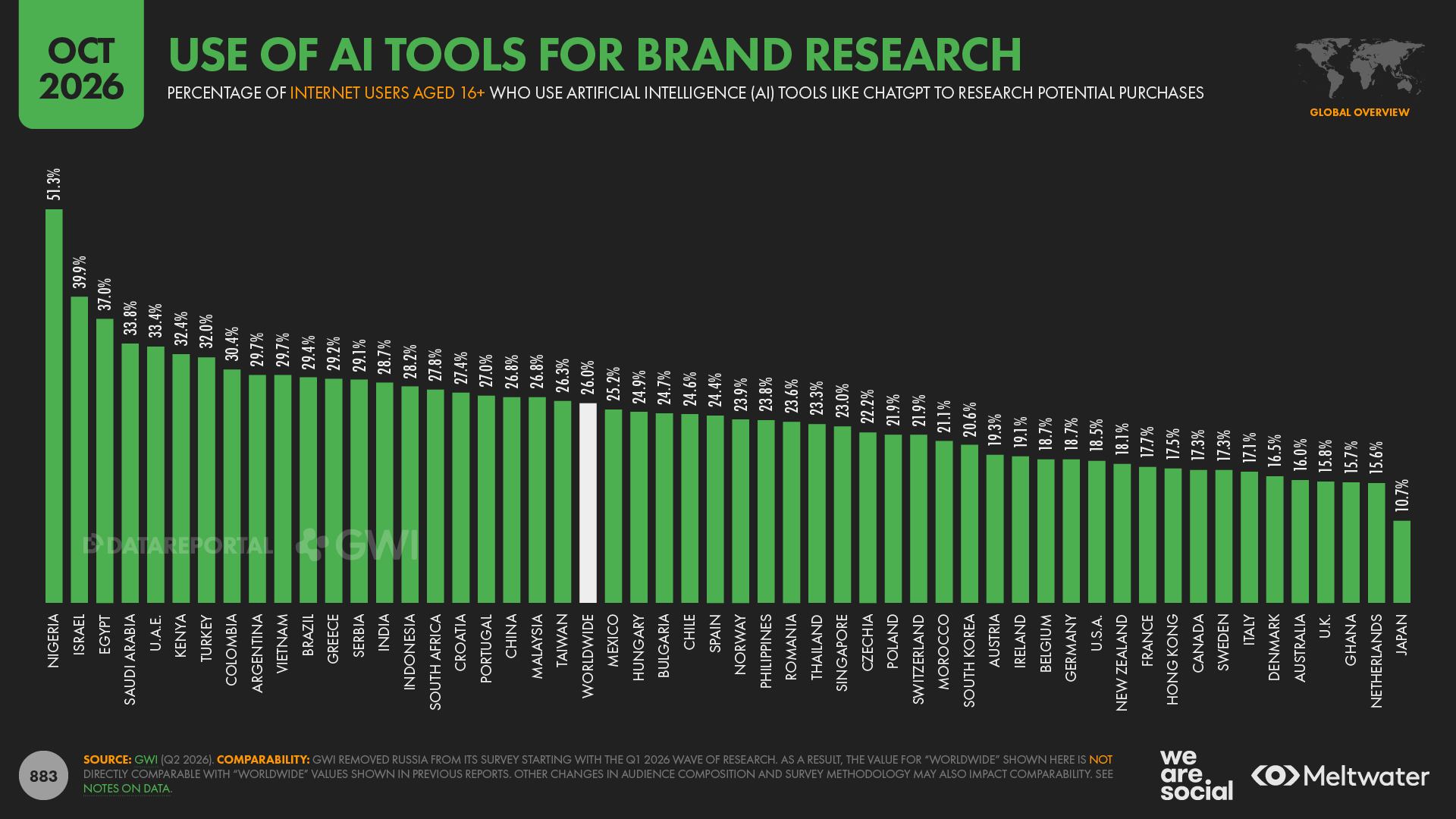
At the top end of the scale, more than half of Nigeria’s online adults – 51.3 percent – say that they use AI tools to research potential purchases, while the same is true for roughly 4 in 10 Israelis.
We also see elevated levels of AI brand research across other countries in the Middle East, with more than 1 in 3 respondents in Egypt (37.0 percent), Saudi Arabia (33.8 percent), and the UAE (33.4 percent) citing this channel.
Things look very different at the other end of the spectrum though, with just 10.7 percent of online adults in Japan saying that they use artificial intelligence when evaluating brands and purchases.
Usage rates are relatively subdued across most of Europe and North America too, with figures in many of these countries well below 20 percent.
AI brand research by gender
It’s also interesting to note that men are meaningfully more likely than women to use AI to research potential purchases.
Across GWI’s worldwide survey audience, 27.6 percent of male respondents say that they use artificial intelligence for brand research, compared with 24.3 percent for women.
And moreover, this gap persists across age groups, even though – on the whole – women are more likely to say that they conduct some form of online research before making a purchase.
AI research: agency vs agentic
However, as Manochi has been discovering through a series of sophisticated studies into how people actually engage with AI when researching potential purchases, most people aren’t yet at the stage where they’re delegating decision making to AI, let alone outsourcing the actual purchase to an AI agent.
Indeed, the shoppers in our studies still appear to be highly engaged with the process of brand research and the selection of individual products, even if they’re relying ever more heavily on AI tools to help them make sense of all the options.
More broadly, our research also demonstrates that people’s AI research behaviours are still evolving rapidly, and that different individuals often adopt completely different approaches to exploring a particular market or purchase.
We’re looking forward to sharing more of our findings from this research in future reports, but please get in touch if you’d like to run one of these studies for your brand or industry.
Disclosure: Simon Kemp is a brand ambassador for GWI.
Click here to see all of Simon’s articles, read his bio, and connect with him on social media.